History
Historical Fiction Research: Victorian Tailoring Behind the Ashworth Series
· Updated 24 September 2026
Discover how Victorian tailoring research, workshop tools and hidden ledgers create the world of AJ Scott’s historical fiction and the Ashworth Series.
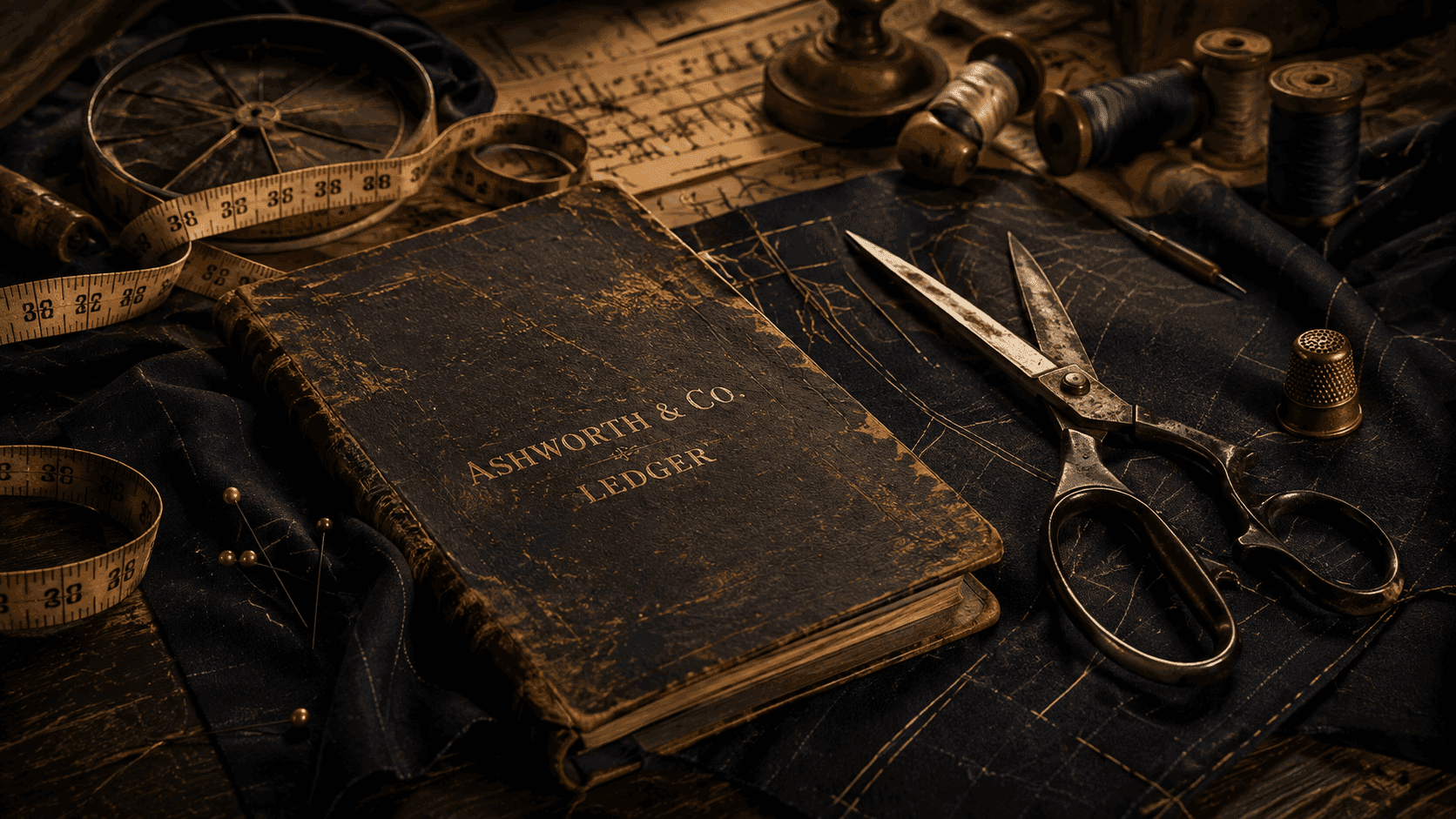
Readers of historical fiction often want two things at once: a convincing past and a story whose human stakes feel immediate. The Ashworth Series brings those qualities together through Victorian tailoring, family ambition and the secrets hidden inside a respected business. This look behind the books explores how historical fiction research turns workshop tools, trade ledgers, fittings and cloth into the foundations of character and conflict.
Where a fictional world begins
A believable historical novel does not begin with a costume rack of attractive details. It begins with questions. How did people work, earn, bargain, travel and protect their reputations? What did they touch every day? Which rules were written down, and which were understood without explanation? Historical fiction research becomes useful when it answers those questions in ways that influence character and plot.
For the Ashworth Series, the doorway into that world was tailoring. A workshop offered more than visual atmosphere. It brought together craft, commerce, class and private ambition. Measurements recorded the body, but they also recorded aspiration. Ledgers tracked payment, yet they could also conceal favour, debt or compromise. A garment crossed boundaries between maker and client, revealing what each person wanted the world to believe.
Reading the evidence left by working lives
Archives often preserve official decisions more readily than ordinary routines. Tailoring history survives in trade directories, advertisements, invoices, account books, pattern systems, photographs, surviving garments and tools. Each source answers a different question. A directory can show where businesses clustered. An advertisement reveals what a shop promised. A worn pair of shears suggests years of repeated movement that no formal record describes.
The most valuable discovery is not always a dramatic fact. It may be the price of a service, the time required for a fitting or the vocabulary used between cutter and customer. Small facts establish the boundaries within which characters can act. Once those boundaries are clear, imagination has something solid to push against.
The workshop as a place of knowledge and power
A tailoring workshop contains its own hierarchy. The person who takes measurements may understand a client’s insecurities before the client admits them. The worker who handles accounts may know which customers pay promptly and which depend on appearances. Apprentices learn through observation, repetition and correction. Skilled hands hold knowledge that money alone cannot purchase.
This makes the workshop ideal for a family saga. It is a workplace, a classroom and a stage on which authority is constantly negotiated. A decision about cloth, credit or timing can carry consequences beyond the garment itself. Craft becomes a source of dignity, but also a source of pressure when the family name depends on flawless performance.
Why ledgers matter in historical fiction
A ledger appears orderly. Names, dates and figures sit in ruled columns, promising certainty. Yet every record is also a selection. Someone decided what to enter, how to describe it and what to leave unrecorded. In fiction, that gap between the visible account and the hidden truth creates possibility.
A healthy balance may disguise delayed payments. An unusual order may connect two people who claim not to know one another. A change in handwriting can indicate illness, absence or a transfer of control. These details work best when they are not added merely as clues. They should belong naturally to the business and become significant because characters understand their meaning differently.
Objects that carry memory
Historical objects are powerful because they outlive the moment of their use. Shears can represent mastery in one generation and threat in another. A thimble may be ordinary to an outsider but precious to the person who remembers its owner. A sample book can preserve fashions, lost clients and choices that shaped the firm.
In the Ashworth world, objects help memory accumulate across the series. Their meaning is never fixed. An inherited tool can feel like a gift, an obligation or evidence of a secret. Repetition allows readers to recognise the object while experiencing a new emotional charge each time it returns.
Turning research into story rather than display
The danger of deep research is the desire to include everything. A novel is not an archive catalogue. Detail earns its place when it affects a decision, sharpens a conflict or changes what the reader understands. The writer may need to know ten facts so that one precise sentence feels effortless.
Good historical detail also arrives through a character’s priorities. A tailor notices drape and construction. A client notices whether the finished coat creates confidence. An accountant notices cost. By filtering the same object through different minds, research becomes characterisation rather than explanation.
The emotional archive behind the Ashworth Series
The archive supporting the Ashworth novels is both historical and emotional. Its documents establish how a business might operate, while its objects reveal what family members remember, protect and misunderstand. Together they make legacy tangible.
That is the deeper purpose of historical fiction research. Accuracy creates trust, but emotional meaning creates connection. Readers do not need to admire every stitch. They need to feel why the stitch matters to the person making it, wearing it or discovering that it has come undone.
Continue exploring
Explore the Books and Series page to discover the Ashworth novels, or return to the Journal for more notes on history, storytelling and the worlds behind the books.